
Sheer is the fabric people want to wear and then leave hanging in the wardrobe. It photographs beautifully, it feels like an occasion, and then the morning comes and the question arrives: what exactly goes under this?
That hesitation is the whole problem, and it is worth solving, because mesh has quietly become one of the most useful things you can own. It travels flat. It does not crease. It works at 32 degrees. And it changes character completely depending on what you put beneath it, which means one top can serve four different occasions.
Here is how to think about it.
The one decision that changes everything
What you layer underneath is not a technicality. It is the design decision. The same mesh dress reads as three different garments depending on that single choice, so make it deliberately rather than grabbing whatever is clean.
You have three broad options.
Tonal, close to your skin
A slip in a shade near your own skin tone is the quietest choice and often the most expensive-looking. The eye reads the print and the silhouette, not the layers. It is the option that lets a loud print behave, and it is almost always right when you are unsure.
Deliberately contrasting
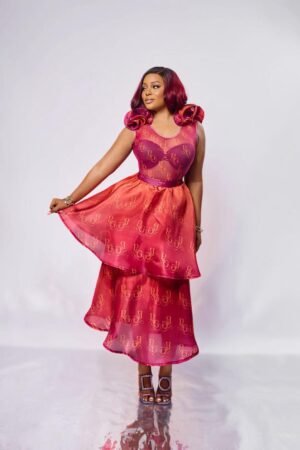
A slip in a colour that fights the print turns the mesh into a veil. A red monogram mesh over a deep navy slip is a different garment from the same mesh over nude. This is the bolder choice and the more interesting one, but it needs commitment. Half-contrast looks like an accident.
Structured, not soft
A fitted bodysuit or a well-made bralette instead of a slip. This is the choice that takes sheer into daytime, because the eye reads structure as intention. It is also the most comfortable option in heat, since you are wearing less fabric overall.
Sheer in daylight, without the drama
Most people assume sheer belongs to evening. It does not. It belongs to whichever hour you dress it for.
The daytime formula is simple: pair the sheer piece with something completely ordinary. Mesh top, straight jeans, flat sandals. The ordinariness of the denim is what makes the mesh read as a considered choice rather than a costume. If both halves of an outfit are trying, the outfit stops working.
This is the same logic behind wearing a formal shoe with casual trousers, or a plain white shirt with an extravagant skirt. One element leads. The other holds still.
Proportion: the rule that does the heavy lifting
If you take one thing from this piece, take this. Sheer wants a counterweight.
When the top half is sheer and close-fitting, give the bottom half volume or length. Wide-leg trousers, a full skirt, something with weight. When the sheer piece is the long one, a floor-length dress for instance, keep everything else contained: a simple shoe, hair off the face, jewellery kept to one or two pieces.
Sheer plus tight plus short in the same outfit gives you nowhere to rest. Sheer plus one generous shape gives you an outfit that looks composed even when you assembled it in nine minutes.
Where sheer actually fails
Being honest about this is more useful than pretending it always works.
- Bad lighting is not your friend. Direct overhead light behaves very differently from evening light. If you are dressing for a venue you have not seen, go with the more structured layer underneath.
- Visible construction ruins it. Seams, labels and hooks that were designed to be hidden will not be hidden. Whatever you wear underneath is now part of the outfit, so it needs to be as good as the outfit.
- Cheap mesh looks cheap immediately. There is very little between you and the fabric, so the quality of the mesh is doing all the work. This is one of the places where paying more is genuinely visible.
Caring for it so it survives
Fine mesh is stronger than it looks and far less forgiving of machines than it looks. The rules are short:
- Hand wash only, in cool water, with a gentle detergent. No exceptions worth taking.
- Do not wring it. Press the water out between your palms or roll it in a towel.
- Never put it in a dryer. Heat is what kills the stretch and the drape at the same time.
- Dry flat or on a padded hanger, out of direct sun, especially with printed or ombre mesh where strong sun will lift the colour.
- Store it folded rather than hanging if it is heavy. A long mesh dress left on a thin hanger for months will stretch at the shoulders.
Done properly, a good mesh piece lasts years. Done carelessly, it lasts one hot wash.
Where to start if you own none of it
Start with a top, not a dress. A top is the lower-risk entry: you can wear it with clothes you already own, and you will learn quickly whether you like the feeling of the fabric before committing to a full-length piece.
Then, if you want one occasion piece, go straight to floor length. The mid-lengths are the hardest to style well. A long sheer column with a good slip underneath is close to foolproof and reads as far more considered than the money you spent on it.
Five outfits, worked out in full
Formulas are more useful than principles when you are standing in front of a wardrobe. These five cover most of what you will need.
1. The Saturday
Fine mesh top, structured bralette or bodysuit underneath, straight-leg denim, flat sandal, one gold hoop. The denim does the anchoring. This is the outfit that teaches you sheer is not a category of event.
2. The office-adjacent
Long-sleeved mesh top over a matching camisole, high-waisted tailored trousers, closed shoe. The camisole matched to the mesh is the detail that makes it read as a printed blouse rather than as sheer at all. If your workplace is conservative, this is the version that passes.
3. The daytime wedding
Floor-length mesh dress, tonal slip underneath, block heel, structured bag. Length plus a quiet slip equals dressed without being exposed, and the airflow through mesh will matter at hour four.
4. The dinner
Mesh top, contrasting slip in a deliberate colour, full skirt or wide-leg trouser, heel. This is where you use contrast on purpose. Evening light is kinder to it and the venue is controlled.
5. The layer-over
Mesh long-sleeve worn over a fitted dress or a slip dress, rather than under anything. Treating a sheer top as an outer layer instead of a base is the move most people never try, and it is the quickest way to make a dress you have already worn twice look new.
The questions people actually ask
What do I wear as a bra?
Whatever you wear becomes visible, so choose it as part of the outfit. A seamless bra in a tone close to your skin disappears. A well-made bralette in a colour that relates to the print becomes a design element. What does not work is a functional bra that was chosen to be hidden, because it will not be.
Will it snag?
Fine mesh catches on rings, watch clasps, bracelets and rough nails more than most fabrics. Take rings off when pulling it on and over your head. If it does snag, do not pull the thread. Work it back through from the reverse with a blunt needle, or leave it; a single pulled thread in mesh is usually invisible once the fabric relaxes.
Can I wear it if I am not tiny?
Yes, and the proportion rule matters more, not less. Sheer is not a size question, it is a structure question. A well-fitted layer underneath and one generous shape elsewhere works on every body. The people for whom sheer looks awkward are usually the ones wearing it tight everywhere at once.
Is it appropriate for church, or for older relatives?
Often yes, in the matched-camisole version described above. Sheer with a full opaque layer beneath it in the same tone reads as texture rather than transparency. This is genuinely a different garment to most observers.
A checklist for buying mesh well
Mesh is one of the fabrics where the gap between good and bad is widest, and it is visible immediately. Before you buy:
- Stretch a section gently and let it go. Good mesh returns to shape. Poor mesh stays slightly distorted, and that distortion becomes permanent at the hips and elbows within a few wears.
- Look at the seams. On sheer fabric every seam is on display. You want narrow, neat, flat seams. Bulky overlocking on a sheer garment is the clearest sign of a corner cut.
- Check the hem and the cuff. These are the hardest parts of mesh to finish well and the first to go wavy.
- Hold it up to light and look for consistency. The weave should be even. Thin patches mean uneven tension on the machine and they will ladder.
- Ask whether it is printed or dyed through. On mesh, a surface print can crack along fold lines over time.
Our monogram mesh tops are the easiest place to begin, and the floor-length mesh dresses are where it gets serious. Both are cut unlined on purpose, so the layer you choose underneath stays yours to decide.