
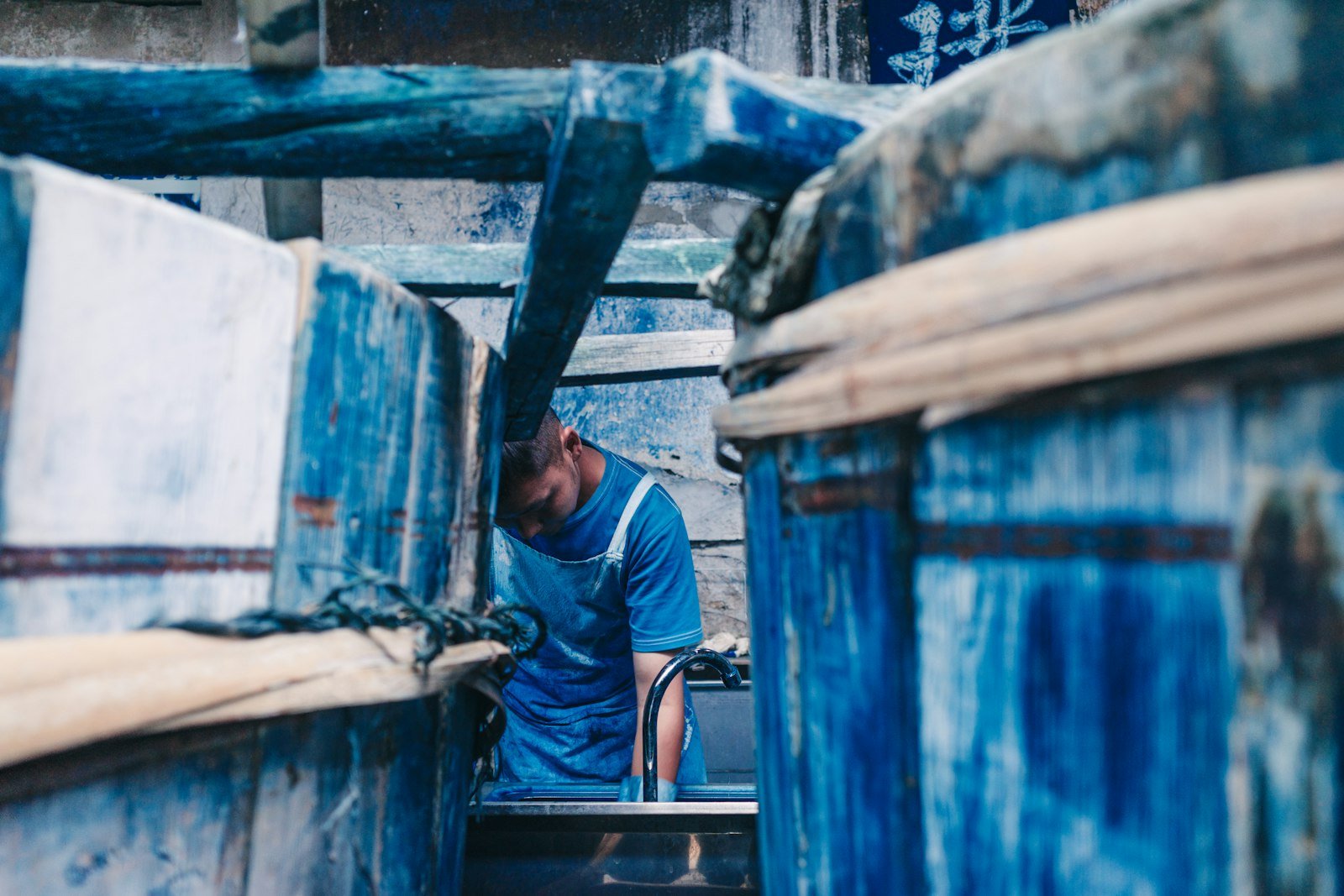
If you have ever looked at two pieces cut from the same adire run and wondered why they do not quite match, the answer is not a fault. It is the entire point of the cloth.
Adire is a Yoruba resist-dyed textile, and the name describes the method rather than a pattern: adi, to tie, and re, to dye. Anywhere the cloth is prevented from taking the dye, the original colour stays. Everything that is beautiful about adire and everything that makes it unpredictable comes from that single idea.
The three ways to stop dye
There are three traditional methods, and most contemporary cloth borrows from more than one.
Adire oniko: tying
Raffia or thread is tied tightly around gathered sections of cloth, sometimes around small objects like seeds or stones. The tied areas resist the dye and emerge as rings and starbursts. This is the method most people recognise, and the one closest to what the rest of the world calls tie-dye.
Adire alabere: stitching
The cloth is hand-stitched in patterns before dyeing, then the stitches are pulled tight so the gathered fabric blocks the dye. After dyeing, every stitch is unpicked by hand. The result is finer and more linear than tying, and considerably more labour.
Adire eleko: paste resist
A cassava starch paste is painted or stencilled onto the cloth, left to dry, and the cloth is then dyed. The paste blocks the indigo, and is washed away afterwards to reveal the pattern. Historically this was the method that carried imagery and proverbs, drawn freehand with a feather or a matchstick by women who had trained for years.
Why no two pieces match
Every stage of that process is done by hand, and every stage introduces variation.
The tightness of a tie varies by millimetres. The dye bath weakens with each batch, so cloth dyed on Friday is not the shade of cloth dyed on Monday. Humidity changes how the paste dries. The length of time in the vat, the number of dips, even the temperature of the water all move the outcome.
Traditional indigo compounds this. Indigo does not dye in a single pass. It oxidises in air, which is why dyers dip the cloth, lift it out to let it turn from green to blue, and dip it again. The number of dips determines the depth. A dyer counts, but a dyer is not a machine.
So when you receive a hand-dyed piece and the swirl sits slightly differently from the photograph, you are not receiving a lesser version. You are receiving the only one of its kind, which is a strange thing to be disappointed by.
How to tell good adire from lazy adire
The market has plenty of printed cloth sold as adire. Printed fabric is not dishonest in itself, but it should not command hand-dyed prices. A few things to look for:
- Check the reverse. Real resist dyeing goes through the cloth. The back of a hand-dyed piece looks like a softer version of the front. A print sits on the surface, so the reverse is noticeably paler or plain.
- Look for irregularity. Perfect repetition is a sign of a roller. Hand work wobbles, and the wobble is the value.
- Look at the edges of the pattern. Dye bleeds slightly where the resist ends. Print has a hard edge.
- Ask what the base cloth is. Good adire is dyed on decent cotton or crepe. The dyeing can be excellent and the cloth still disappointing.
Caring for hand-dyed cloth
This is where most pieces are lost, and it is entirely avoidable. Hand-dyed fabric has dye sitting in the fibre rather than fixed with the industrial processes used on commercial prints, so it needs a gentler life.
- Wash it alone the first few times. Some loose dye will come out. This is normal and it is not a defect. It is also why it should not meet your white shirt.
- Cool water, hand wash, mild detergent. Hot water opens the fibre and lets dye escape. Biological detergents and anything containing bleach will lift colour.
- Do not soak it. Ten minutes is plenty. Leaving hand-dyed cloth sitting in water is the fastest way to a muddy, flattened pattern.
- Dry in shade. Direct Lagos sun on wet dyed cloth will fade it visibly in a single afternoon.
- Iron on the reverse, medium heat. Direct high heat on the face can glaze the dyed areas and leave them shiny.
- Never tumble dry. Heat plus friction is the worst combination available to you.
How to wear it now
The instinct with a strong hand-dyed print is to treat it as heritage dress and reserve it for cultural occasions. That is a waste of a very versatile cloth.
Adire behaves like any other bold print. It wants one loud element and everything else quiet. A full adire two-piece is a complete outfit on its own and needs nothing more than a good shoe. Split the same set and each half becomes far more useful: the trousers with a plain white shirt, the top with denim or with tailored black.
That splitting is worth planning for at the point of purchase. A set you can wear three ways is a better buy than a dress you can wear one way, even when the dress is cheaper.
Where adire comes from
Adire is associated above all with Abeokuta, in Ogun State, and with Egba women who built it into a serious commercial craft. By the early twentieth century it was a trade with real economic weight, run largely by women, with dyeing compounds, apprenticeships and established routes to market across West Africa.
Two things changed it. The first was imported cloth: cheap, wide, evenly woven cotton shirting arriving through the ports, which replaced narrower hand-woven cloth and let dyers work at a larger scale. The second was the arrival of synthetic dyes and, later, screen printing, which could imitate the look of adire in a fraction of the time and at a fraction of the cost.
That is the background to the market you are buying in today. Hand-dyed adire did not disappear, but it now sits alongside a great deal of printed cloth that borrows its appearance. Knowing the difference is not snobbery. It is the difference between paying for a week of skilled labour and paying for a roller.
Indigo, and why the colour behaves oddly
Traditional adire uses indigo, from elu, and indigo does not behave like other dyes.
Indigo is not soluble in water in its blue form. It has to be chemically reduced in a vat into a soluble yellow-green state before cloth will take it at all. The cloth comes out of the vat looking green, and then, in front of you, oxidises in the air and turns blue. Dyers judge depth by the number of dips, not by time in the bath, because each dip adds a layer.
Two consequences follow, and both affect you as a wearer.
First, indigo sits on the fibre in layers rather than bonding deep inside it the way many modern dyes do. That is why genuinely indigo-dyed cloth crocks, meaning it transfers a little colour onto skin or onto a pale seat, particularly when new and particularly when damp. It is a property of the dye, not a fault in the garment.
Second, it is why indigo ages so well. As those surface layers wear back very gradually, the cloth softens in tone rather than going patchy. It is the same reason good denim ages the way it does, and it is why old adire often looks better than new adire.
What you are paying for
It is worth being concrete about the labour, because the price of hand-dyed cloth is frequently questioned by people who have never watched it being made.
For a stitched piece, someone hand-sews the resist pattern across the entire length of cloth. That alone can take a day or more. The cloth is then dipped repeatedly with oxidation time between each dip. It is rinsed, dried, and then every one of those stitches is unpicked by hand without cutting the cloth. Then it is washed again, dried again, and only then is it ready to be cut and sewn into a garment.
Before a single pattern piece is cut, several days of skilled work have gone into the fabric. The garment cost sits on top of that. When you see hand-dyed adire priced like printed cotton, someone in that chain is not being paid.
Common questions
My piece smells faintly of something earthy. Is that normal?
With genuine indigo, yes, especially when new or damp. It fades with airing and a first gentle wash.
Some dye came off on my hands. Have I been sold something faulty?
Almost certainly not. See crocking above. It reduces substantially after the first few washes. Wash the piece alone, and be careful with pale upholstery and pale bags in the first weeks.
Can I dry clean it?
Ask the maker first. Many hand-dyed pieces do not respond well to standard solvents, and a dry cleaner who does not know the cloth may treat it like a commercial print. Gentle hand washing is usually both safer and better.
The two halves of my set are slightly different in tone.
If they were cut from different parts of the cloth, or from cloth dipped in different batches, this is expected. It is also, genuinely, the thing that tells you it was not printed.
How do I stop it fading?
Shade drying and cool water do most of the work. Sunlight is the single biggest cause of fading in dyed cloth, and a few hours of direct Lagos sun on a wet garment does more damage than months of wearing it.
Our adire crepe set is cut with exactly that in mind: a halter peplum top and wide-leg trousers that work together and separately, in a crepe chosen because it holds the dye deeply and still moves. It is made in three colourways, and as you now know, no two of them dye exactly alike.